
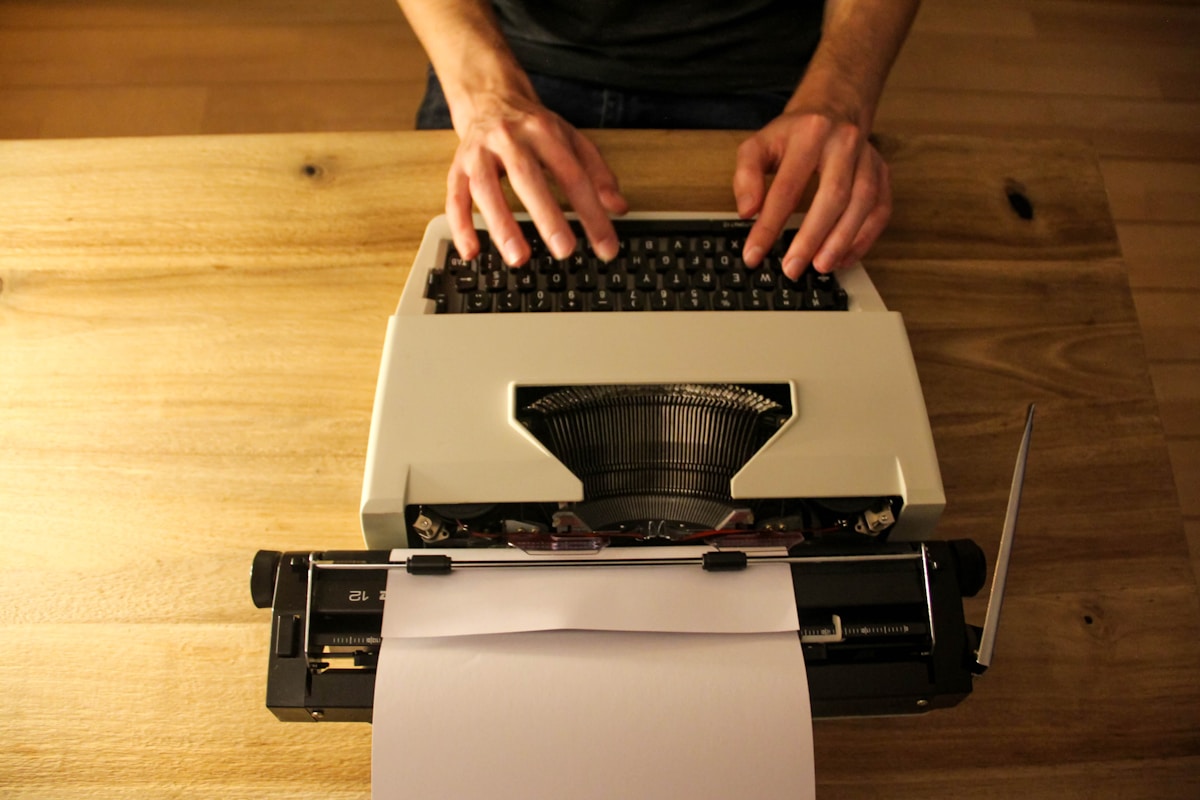
The submission bin appeared in the hallway on a Monday in January 2026. Metal, institutional gray, bolted to the wall outside Room 314. No digital portal. No file upload. Students in Professor Mitchell’s composition course would turn in essays the way their grandparents had: on paper, typed on machines without memory, spell-check, or network cards. The syllabus was explicit. Assignments completed on computers would receive no credit, regardless of quality.
The policy lasted one week before the student newspaper published it. Two weeks before it reached education Twitter. By week three, Mitchell had fielded interview requests from outlets in seven countries and angry emails from parents who had paid premium tuition expecting their children to learn marketable skills, not Cold War nostalgia. The typewriter requirement became a meme, then a case study, then something harder to categorize: evidence that institutional confidence in distinguishing human from machine work had collapsed entirely.
Mitchell’s decision was not pedagogical experiment. It was surrender dressed as principle.
What Detection Actually Detects
The mechanics matter. AI detection tools marketed to educators—Turnitin’s AI writing indicator, GPTZero, Originality.AI—operate on pattern recognition, not truth verification. They analyze text for statistical signatures: perplexity measures (how surprising word choices are), burstiness analysis (variation in sentence structure), and lexical diversity scores. When these metrics fall within certain ranges, the software flags the submission as potentially AI-generated.
The operative word is “potentially.” In December 2025, a Stanford-affiliated study tested seven leading detection platforms against a controlled set of 500 student essays: 250 human-written, 250 AI-generated with light human editing. The false positive rate—human work incorrectly flagged as AI—ranged from 8% to 31% depending on the tool. The false negative rate ran higher. Students who generated essays with Claude or ChatGPT, then manually adjusted sentence rhythm and injected deliberate errors, evaded detection 61% of the time.
The tools improve monthly. So do the evasion techniques. Mitchell had watched the cycle for three semesters before abandoning it. “I spent more time investigating plagiarism claims than teaching writing,” she told the campus technology committee in February. “And I was wrong as often as the software.”
The typewriter policy eliminated the ambiguity. A document produced on a 1987 Brother AX-25 contains no AI fingerprint because it contains no AI. The logic is airtight. The implications are not.
The Room Where Skills Are Decided
Mitchell’s classroom became something rare in 2026: a space where the central question was not *did you use AI* but *can you think without it*. Students arrived at 9 a.m. sessions with yellow legal pads and mechanical pencils. They drafted outlines by hand, crossed out sentences, rewrote paragraphs in margins. The physical artifact of revision was visible in a way digital Track Changes never made it.
The quality of the work changed. First submissions showed sharper decline than Mitchell anticipated—spelling errors she had not seen in years, organizational problems that autocomplete and grammar tools had quietly masked. By week six, the trajectory reversed. Sentence clarity improved. Arguments took structural risks that algorithmic suggestions tend to smooth out. Students who had submitted flawless but generic essays under the old system began turning in flawed, interesting ones.
One junior, previously a reliable B+ student, turned in a typed essay with three paragraphs crossed out in pen and rewritten in the margins. Mitchell graded it A-minus. The student’s previous semester average, with full digital access: B+. The earlier work had been competent, polished, indistinguishable from AI output. The typewriter essay was messy and alive.
The correlation is not proof. But it asks a question the AI detection education debate has mostly avoided: what if the problem is not that we cannot detect AI use, but that we have spent a decade rewarding writing that resembles what AI produces?
What Institutions Are Quietly Changing
Mitchell’s typewriter policy is an outlier in method but not in direction. Seventy-three universities across North America revised assessment policies between January and April 2026, according to data compiled by the American Association of Colleges and Universities. The revisions share a pattern: movement away from take-home written assignments toward in-class composition, oral examinations, and project-based assessment with mandatory process documentation.
Duke’s economics department now requires students to submit three intermediate drafts for every paper, each annotated with handwritten margin notes explaining revision choices. Northwestern’s journalism school replaced its capstone research paper with a live interview and source analysis conducted in a proctored lab. The University of Michigan’s engineering program added mandatory “design justification” sessions where students defend technical choices in real-time conversation with faculty.
These are not anti-technology positions. They are anti-opacity positions. The institutions are redesigning assessment around the assumption that text alone no longer proves learning, because text alone can now be generated by anyone with an internet connection and minimal prompt literacy.
Corporate learning and development divisions face the same reckoning. A Fortune 500 technology company—leadership requested anonymity to discuss internal training changes—eliminated written case study assignments from its management development program in March 2026. The replacement: participants now conduct live strategy presentations to senior executives, defending recommendations under direct questioning. The head of talent development put it plainly in an internal memo: “We need to know what people can do when the chatbot is not in the room.”
“We are not preparing students for a world without AI. We are preparing them for a world where everyone has AI, and the differentiator is what you do with access to the same tools.”
The quote comes from an associate dean at a mid-sized liberal arts college in Ohio. She asked not to be named because her institution has not yet announced the policy changes her committee is drafting: elimination of unproctored written exams by fall 2027, increase in oral assessment from 15% to 40% of final grades, and a required first-year seminar on “working in cognitive partnership with AI tools.”
The phrase “cognitive partnership” appears in seven different institutional policy documents reviewed for this story. It represents an attempt to move past the detection stalemate toward a different question: not whether students use AI, but whether they can operate as the intelligent agent in a human-AI system.
The Economic Pressure No One Is Saying Aloud
AI detection education has a cost problem. Turnitin charges institutions between $3 and $6 per student annually for its AI writing detection feature. GPTZero’s institutional licenses start at $7,500 per year for mid-sized universities. Originality.AI runs $0.01 per credit—100 words of scanned text—which translates to roughly $15,000 annually for a university processing 50,000 student submissions.
Schools are paying for tools that faculty increasingly distrust. A February 2026 survey of 1,200 college instructors conducted by Inside Higher Ed found that 41% had stopped using AI detection software, up from 22% in September 2025. The most common reason cited: “too many false accusations.” The second most common: “students know how to beat it.”
The software vendors respond to criticism with version updates, model refinements, improved accuracy claims. The accuracy does improve—incrementally, insufficiently. OpenAI releases a new model. Detection tools recalibrate. Students discover the new evasion patterns within weeks. The cycle runs faster than institutional purchasing schedules.
Meanwhile, the typewriter market is experiencing something between irony and resurgence. Brother sold 4,200 manual typewriters in North America in 2023. In the first quarter of 2026, that figure hit 3,800. Most buyers are not students. They are schools.
What Gets Lost in the Mechanism
The turn away from digital submission solves the detection problem by eliminating the detection question. But it creates a different set of questions, ones that resist clean answers. If students cannot use AI tools in academic work, what happens when they enter workplaces where AI use is not just permitted but expected? If writing instruction focuses on pre-digital composition skills, does that prepare learners for an information environment where text generation is functionally free?
Mitchell’s students graduate in May 2026. They will enter job markets where colleagues draft emails with Gemini, generate reports with Claude, and refine presentations with ChatGPT. The typewriter semester taught them to write without algorithmic assistance. It did not teach them to write with it effectively, to prompt with precision, to edit AI output with critical judgment, or to know when human composition is worth the time cost.
Some institutions are attempting the harder path: not banning AI, but teaching explicit AI literacy as a compositional skill. Arizona State University’s first-year writing program now includes a unit on prompt engineering, output evaluation, and “when to generate versus when to compose.” Students submit both the AI-generated draft and their edited final version, with a required reflection document explaining every change made and why.
The approach requires more faculty time, more granular feedback, and comfort with ambiguity that institutional policy tends to resist. It also requires admitting that AI detection education as currently practiced—software scans, percentage scores, binary judgments—cannot do what institutions need it to do.
The technology will improve. Detection algorithms will get better. So will generation models. The fundamental asymmetry remains: it is harder to prove a text is human-written than to generate a plausible simulation of human writing. That asymmetry is not a temporary technical problem. It is a permanent condition of the information environment.
FetchLogic Take
By January 2028, more than 200 U.S. colleges will have eliminated unproctored written assignments as primary assessment tools in foundational courses. The shift will not be driven by pedagogical conviction but by legal liability: the first successful lawsuit from a student wrongly accused of AI use based on detection software will settle for mid-six figures before the end of 2026, and institutional risk officers will take note. The typewriter moment is not about romanticizing analog tools. It is the canary: institutions have lost confidence in their ability to verify the provenance of student work, and they are redesigning assessment architecture around that loss. The schools that adapt fastest will not be the ones that ban AI or the ones that embrace it unconditionally. They will be the ones that stop trying to detect AI use and start measuring what students can do when the performance cannot be delegated to a language model. That requires knowing what those capabilities are. Most institutions have not yet had that conversation.
AI Tools We Recommend
ElevenLabs · Synthesia · Murf AI · Gamma · InVideo AI · OutlierKit
Affiliate links · we may earn a commission.