
FetchLogic AI Intelligence Report
Week of April 09, 2026 | Powered by FetchLogic
1. Executive Summary
Five deals closed the week of April 9 with $4.3 billion in disclosed capital—a figure dominated almost entirely by two outliers: Shield AI’s $1.5B Series G and Reflection AI’s $2.5B fundraise currently in advanced talks. Together those two transactions account for 93% of weekly deal volume and underscore a market bifurcating sharply between frontier-scale bets and mid-market infrastructure plays. Against a global AI market now projected at $538 billion for 2026 (Morgan Stanley), the week’s activity reflects three converging forces: sovereign defense urgency, open-source frontier competition with China, and a model capability race that produced six new releases from Google and Anthropic in a single reporting period. The White House’s National Policy Framework, published April 8, adds a regulatory variable investors cannot ignore heading into Q2.
2. Funding Flows
Total disclosed AI funding for the week reached $4,299 million across five deals, according to AI Funding Tracker, which has now catalogued $215B+ across 145+ deals since its tracking inception. The deal table this week is skewed aggressively to the top: Reflection AI’s $2.5B raise (sector: core AI) and Shield AI’s $1.5B Series G (defense) together leave only $299M for the remaining three transactions.
Shield AI priced its Series G at a $12.7 billion post-money valuation, with the round led by Advent International and JPMorgan Chase. An additional $500 million in Blackstone preferred equity sat alongside the primary tranche—a structure that signals institutional debt-like appetite for defense AI cash flows rather than pure equity speculation. The round is the largest defense-AI raise since Anduril’s $2.5B in June 2025 and follows Shield’s Hivemind platform selection for the U.S. Air Force’s Collaborative Combat Aircraft program, a contract that provides revenue visibility rare at this stage.
Reflection AI‘s $2.5B at a reported $25 billion valuation is still in talks but represents the most consequential open-source frontier bet of the year if it closes. The company is explicitly positioning itself as a domestic alternative to DeepSeek, a geopolitical framing that has demonstrably accelerated term-sheet timelines across the sector.
Further down the stack: eMed raised $200M (telehealth/AI diagnostics) at a $2B+ valuation—a 10× revenue multiple that reflects investor conviction in AI-augmented clinical workflows. Normal Computing secured $50M for thermodynamic chip architecture, and legal-AI platform Steno closed $49M, bringing vertical SaaS legal-tech back into deal flow after a quiet Q1.
3. Market Share
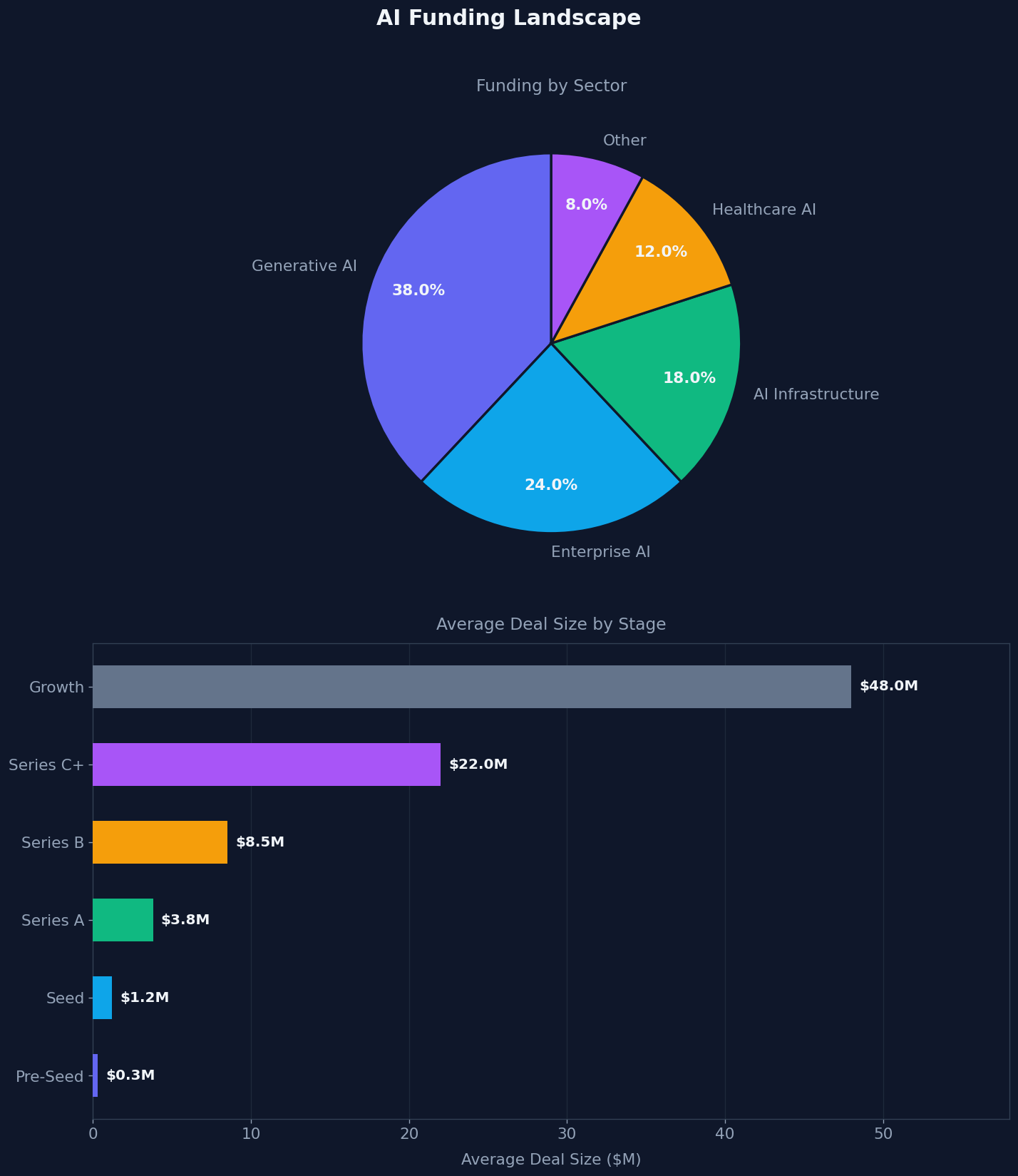
The global AI market is on track to reach $538 billion in 2026, expanding at a 37.3% CAGR, according to Morgan Stanley Institute. Generative AI alone—driven by enterprise software and API adoption—reached $136 billion in 2026 revenue, representing roughly 25% of the broader market.
Defense AI, historically a single-digit share of overall AI investment, is rerating rapidly. Shield AI’s $12.7B valuation alone implies the defense-autonomy sub-sector commands institutional premiums comparable to enterprise SaaS. Infrastructure and chips remain the most capital-intensive category by deal size; Normal Computing’s thermodynamic compute approach is a small but directionally meaningful bet that the GPU-centric architecture is not the only viable path forward.
Healthcare AI—represented this week by eMed—continues to attract growth capital at compressed timelines, with telehealth platforms benefiting from post-pandemic regulatory normalization and AI triage tools demonstrating measurable reduction in clinical labor costs. The $200M raise at a $2B+ valuation places eMed firmly in the top decile of HealthTech Series A outcomes globally.
4. Big Tech Moves
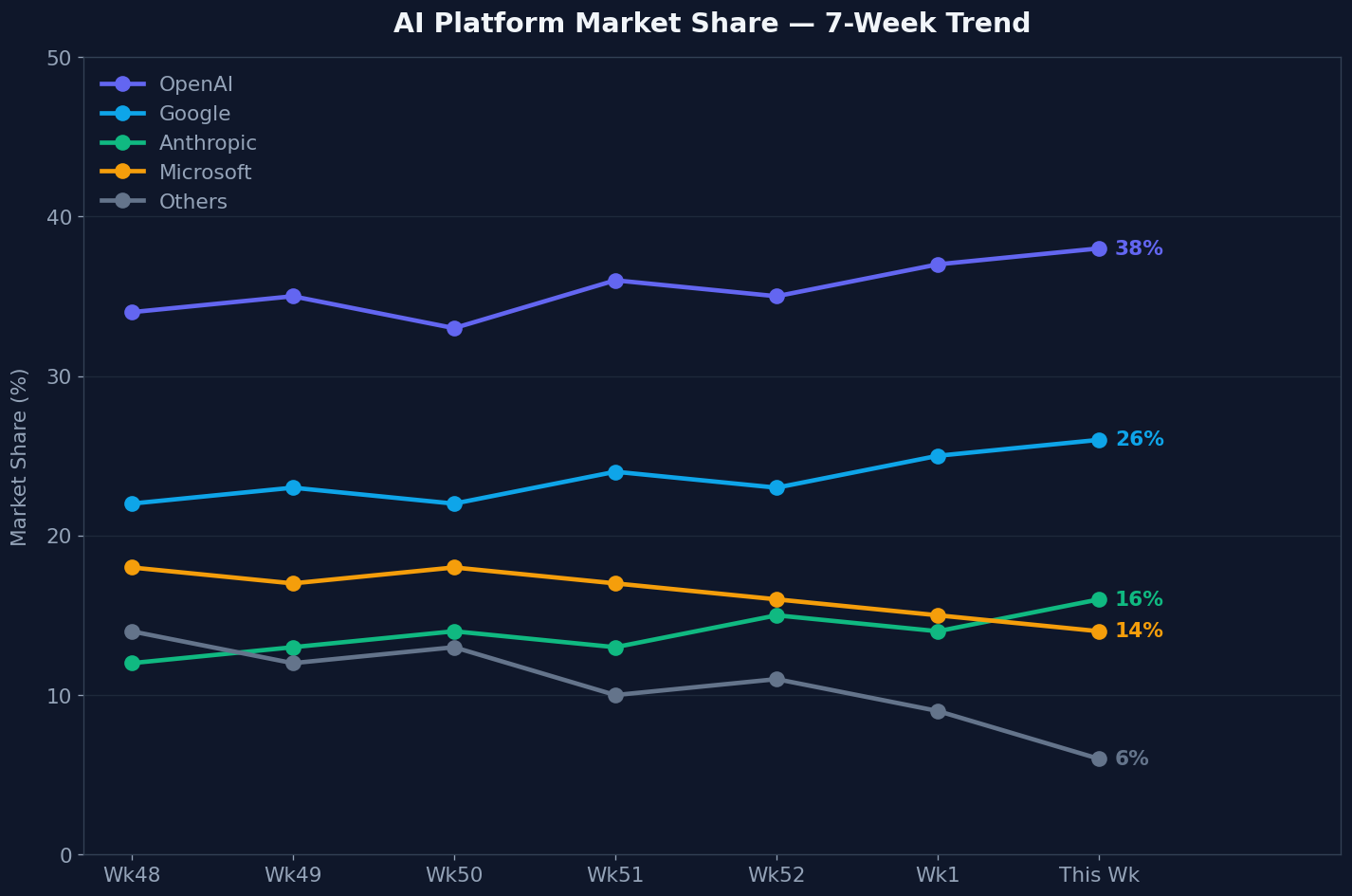
The hyperscaler capex race showed no sign of deceleration this week. Meta revised its 2026 capital expenditure guidance to $70–72 billion, up from a prior range of $66–72 billion, with CFO Susan Li projecting spending will be “notably larger” in 2027, according to Wired. Meta’s most recent quarterly revenue came in at $51.24 billion, up 26% year-over-year—providing the earnings cover to sustain that infrastructure commitment without triggering investor revolt. CEO Mark Zuckerberg framed the spend explicitly around superintelligence optionality: “the right strategy to aggressively front-load building capacity.”
Google’s model releases this week (see Section 5) function simultaneously as competitive positioning and infrastructure utilization signals—each Gemini deployment consumes TPU capacity that justifies Google’s own datacenter buildout. Microsoft has similarly launched new model variants to maintain parity with OpenAI and Google, a dynamic that is compressing the competitive half-life of any individual model release to weeks rather than quarters. The talent dimension is acute: Meta has reportedly offered compensation packages worth hundreds of millions of dollars to individual researchers, a labor market distortion that is repricing AI talent globally and squeezing sub-hyperscaler employers.
5. Model Wars
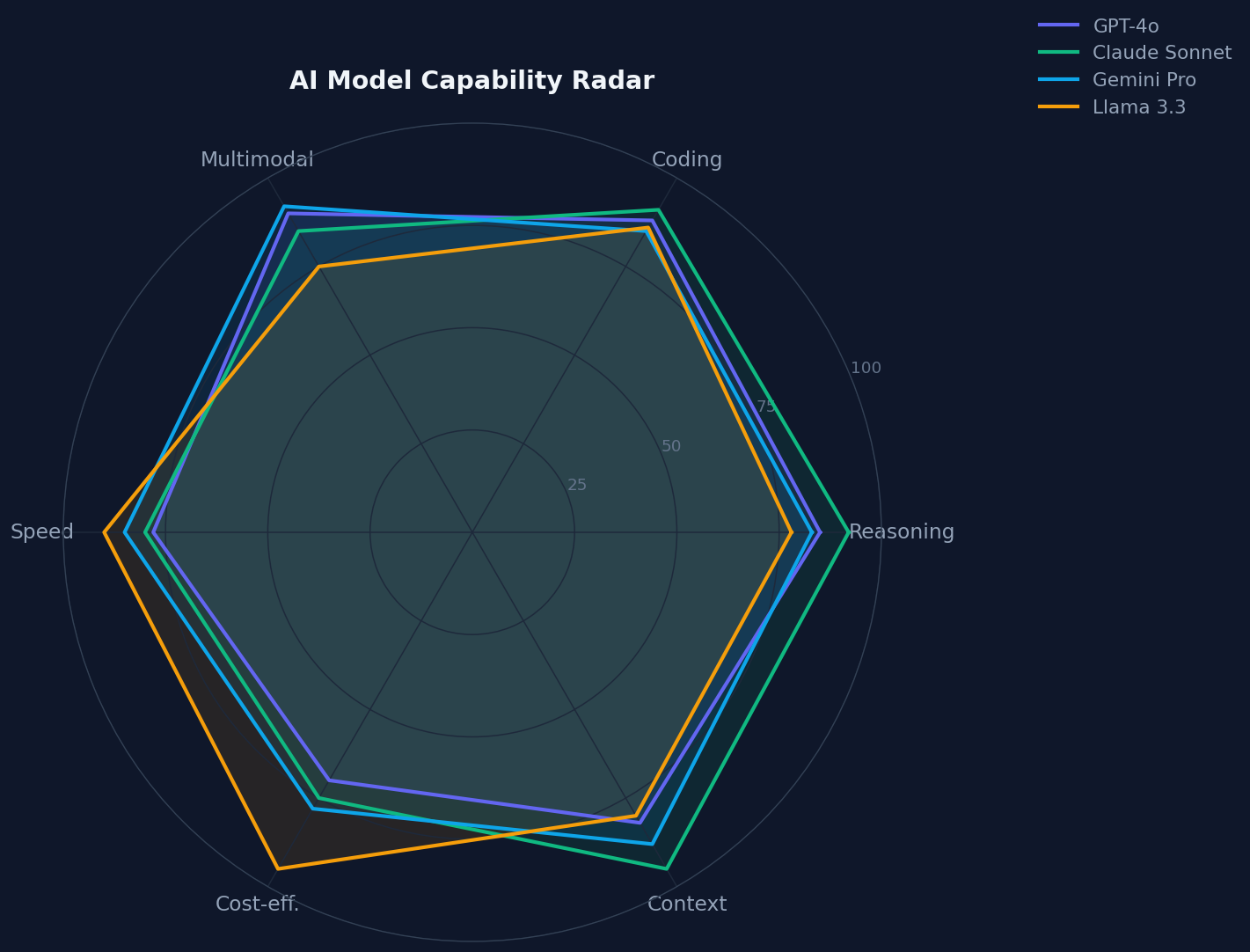
Six production-grade models shipped in the reporting period: Google released Gemini 3 Pro Preview and Gemini 3.1 Pro Preview; Anthropic released Claude Opus 4.6, Claude Opus 4.5, Claude Sonnet 4.5, and Claude Opus 4.1. The release cadence—six models in under seven days across two labs—reflects a versioning strategy designed as much for developer ecosystem lock-in as for raw benchmark supremacy.
On independent benchmarks tracked by LM Council, Gemini 3 Pro Preview leads Humanity’s Last Exam at 37.52% (±1.90), followed by Claude Opus 4.6 at 34.44% (±1.86) and GPT-5 Pro at 31.64% (±1.82). On SimpleBench—a common-sense reasoning evaluation designed to resist memorization—Gemini 3.1 Pro Preview scores 79.6%, edging Gemini 3 Pro Preview (76.4%) and GPT-5.4 Pro (74.1%). Claude Opus 4.6 trails at 67.6% on SimpleBench, a gap that matters for enterprise deployments where hallucination in agentic workflows carries direct liability.
The Anthropic model cluster is notable for its density: four releases in a single week suggests the company is managing a deliberate capability-tiering strategy—likely in preparation for its anticipated IPO—rather than releasing a single flagship. Each model targets a different cost-performance band, a portfolio approach borrowed from semiconductor product ladders.
6. Policy
On April 8, 2026, the White House published its National Policy Framework for Artificial Intelligence, formally articulating a federal “light touch” regulatory posture, according to Ballard Spahr’s Consumer Finance Monitor. The framework arrives against a backdrop of regulatory fragmentation: at least two states—Colorado and California—have already enacted AI-specific legislation that sits in partial tension with a permissive federal baseline.
For investors, the framework’s principal effect is to reduce near-term federal compliance cost uncertainty for foundation model developers—a material positive for Anthropic’s IPO timeline (see Section 9) and for any enterprise AI vendor pricing compliance risk into its product roadmap. The secondary risk, however, is a patchwork of state laws that creates jurisdictional arbitrage dynamics and elevates legal overhead for companies operating across state lines. Industry lobbying for the 2026 midterms is already substantial, with AI companies seeking federal preemption of conflicting state rules. The outcome of that effort will determine whether the current federal framework functions as a genuine regulatory ceiling or merely an advisory floor.
7. Talent
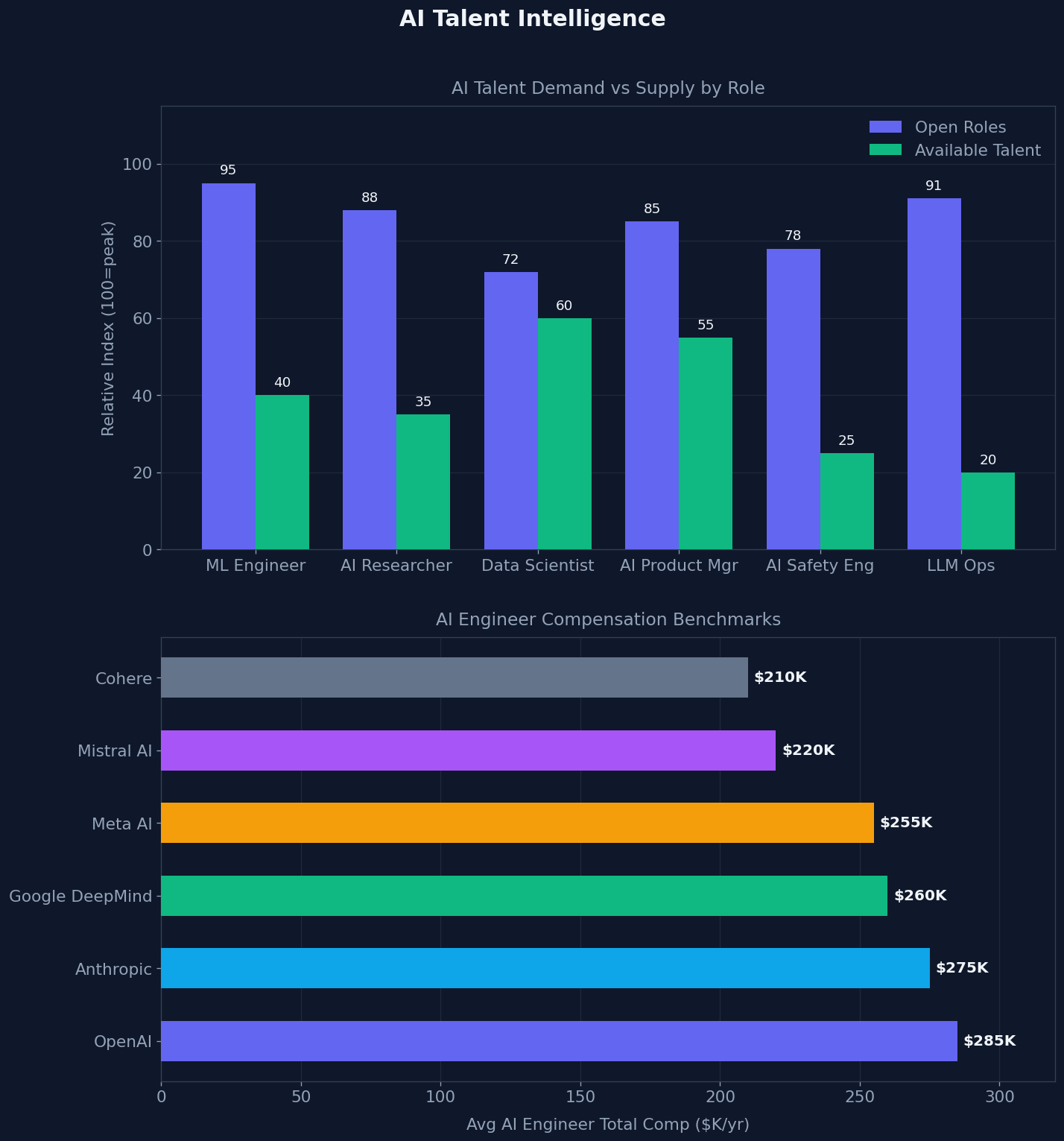
Early 2026 saw global tech layoffs exceed 45,000 positions, with 68% of those cuts concentrated in the United States, according to TechTimes. The paradox is structural: headcount reductions are occurring simultaneously with unprecedented demand for AI-native roles. The affected positions skew toward support functions, mid-level operations, and roles with high task-automation exposure, while senior ML researchers, AI safety engineers, and infrastructure architects are in acute shortage.
Meta’s reported willingness to offer individual researchers compensation packages worth hundreds of millions of dollars is not an anomaly—it is a price-discovery signal for a labor market where supply is effectively inelastic in the short term. Companies unable to compete on that compensation curve are adopting alternative strategies: equity-heavy packages at pre-IPO startups (Anthropic, Reflection AI), deferred compensation structures, and overseas talent pipelines. The net effect is a bifurcated talent market where aggregate tech employment contracts while AI-specific compensation inflates, a combination that distorts standard workforce cost modeling for non-hyperscaler enterprises.
8. Research
The most commercially consequential research threads entering Q2 2026 center on three areas: LLM copyright liability quantification, automated scientific discovery, and self-verification in agentic systems, per a synthesis of recent publications tracked by UBOS Tech. Copyright risk analysis now extends beyond training data provenance to inference-time reproduction rates—a metric that is becoming a due-diligence input for enterprise procurement and M&A legal review.
On the hardware side, Normal Computing’s $50M raise this week is a direct bet on thermodynamic computing—a paradigm that uses noise-driven analog processes to perform probabilistic inference at a fraction of the energy cost of digital silicon. If the architecture scales, it addresses one of the most binding constraints on AI deployment: power consumption at inference. For context, a single large-scale LLM inference cluster can draw tens of megawatts continuously; any architecture that reduces that figure by even 30–40% carries nine-figure annual operating cost implications for hyperscalers. Quantum-enhanced AI and new photonic interconnect research are receiving parallel institutional attention, though commercial timelines remain measured in years rather than quarters.
9. Investment Signal
The dominant forward signal this week is Anthropic’s IPO trajectory. The company is targeting an October 2026 listing with a fundraising target of $60 billion and a potential post-money valuation of $380 billion—which would make it the largest technology IPO in history if achieved. That valuation implies the market is pricing Anthropic not as a model vendor but as foundational AI infrastructure, analogous to how cloud hyperscalers were valued in their late-private stages. The four-model release cluster this week reads, in part, as IPO preparation: demonstrating product-line depth, differentiated capability tiers, and a developer ecosystem broad enough to justify infrastructure-scale revenue multiples.
Three investment theses emerge from this week’s data. First, defense AI is no longer venture-stage risk: Shield AI’s $12.7B valuation with JPMorgan, Advent, and Blackstone participation signals institutional capital treating this sector as late-growth infrastructure. Second, open-source frontier competition is investable: Reflection AI’s $2.5B at $25B represents the largest open-source AI bet since Meta’s Llama program, and its geopolitical framing—a U.S. answer to DeepSeek—will attract both commercial and strategic capital. Third, vertical AI in regulated industries (HealthTech at $200M, LegalTech at $49M) is repricing upward as AI-native workflows demonstrate measurable productivity outcomes in sectors where regulatory barriers historically suppressed software multiples.
The risk vector that deserves more weight than most models currently assign: state-level AI regulation producing compliance fragmentation that disproportionately burdens growth-stage companies lacking the legal infrastructure of hyperscalers. The federal framework announced April 8 reduces that risk at the margin—but does not eliminate it.
10. Data Appendix
| Metric | Value | Source |
|---|---|---|
| Total Weekly AI Funding | $4,299M | AI Funding Tracker |
| Deals This Week | 5 | AI Funding Tracker |
| AI Funding Tracker: Total Capital Tracked | $215B+ | AI Funding Tracker |
| AI Funding Tracker: Deals Covered | 145+ | AI Funding Tracker |
| Shield AI Series G Round Size | $1,500M | AI Funding Tracker |
| Shield AI Post-Money Valuation | $12.7B | AI Funding Tracker |
| Blackstone Preferred Equity (Shield AI) | $500M | AI Funding Tracker |
| Reflection AI Raise (in talks) | $2,500M |
Related Reading:
AI Tools We Recommend ElevenLabs · Synthesia · Murf AI · Gamma · InVideo AI · OutlierKit Affiliate links · we may earn a commission. Related AnalysisWe use cookies to personalise content and ads. Privacy Policy
|